
Skip to content

Trade Show Construction Materials: A Guide to Sustainable Brand Architecture

It is no secret that sustainability and environmental responsibility are becoming increasingly essential in the trade show and event industry, presenting specialized planners with complex technological and design challenges. However, what truly enables companies to bring their brand values to life in spatial design is a deep understanding of material cycles and deliberate material selection. Choosing the right materials and partnering with responsible suppliers helps utilize resources more efficiently and extends the overall lifespan of exhibition materials. This article highlights the demands placed on modern materials widely used in trade show construction and provides clear guidance for planning resource-conserving projects. Ultimately, precise material planning and selection are the issues that form the necessary foundation for future-proof brand experiences in an international trade show environment.

Core Trade Show Materials for Immersive Brand Experiences

The targeted selection of materials plays a decisive role in driving resource efficiency, streamlining logistical planning, and enabling project scalability. Beyond pure aesthetic impact, factors such as material origin, reusability, supply chain transparency, and end-of-life recycling options are becoming increasingly vital. Taking a holistic view of these criteria allows brands to use resources more consciously and optimize material flows throughout the project lifecycle.

Material Properties of Wood and Aluminium

Wood and aluminum are well-established trade show construction materials valued for building stable, durable structures. Depending on project demands, both materials offer distinct advantages in craftsmanship, reusability, and architectural flexibility. For wood, material origin and recognized certifications are critical, whereas aluminum is widely favored in modular systems for its exceptional durability and recyclability. For instance, using certified reclaimed wood significantly reduces the carbon footprint, directly enhancing the environmental profile of the brand architecture. Aluminum, in turn, allows modular frame systems used for the exhibit stands to be reused across numerous deployments and easily adapted to varying requirements. Reusing high-grade components over the long term maximizes resource efficiency, keeps existing materials in circulation longer, and effectively eliminates disposal costs.

Close-up of wood and aluminum used for a trade show booth.


Innovative Textiles and Composite Systems

Lightweight fabrics enable flexible spatial design while simplifying transport and handling demands. Engineered predominantly from recycled polymers, many modern textiles are built for long-term use and can be repurposed or returned to established recycling streams depending on their material composition and available infrastructure. Furthermore, lightweight materials help streamline logistics processes and optimize overall resource utilization throughout the project lifecycle.

Selection Criteria for Sustainable Materials in Trade Show Construction

Evaluating material sustainability in trade show construction requires a systematic analysis of technical data to ensure objective comparability. Alongside performance specifications, factors such as material origin, supply chain integrity, reusability, and recycling pathways are gaining major importance. Specialized planners rely on defined evaluation criteria to vet various trade show materials against specific project requirements. This structured framework ensures transparent, responsible project execution from the initial sketch to final assembly.

Vetting Certifications and Material Origin

International certifications such as FSC or Cradle-to-Cradle offer reliable guidance for meeting rigorous social and environmental standards. These seals empower specialized planners to incorporate verified data regarding origin, supply chains, and defined eco-criteria directly into their material selection. Furthermore, transparent sourcing documentation ensures sustainability goals are communicated clearly and supports well-informed decision-making along the value chain. Ultimately, procurement transparency builds deeper brand trust and safeguards against reputational risks.

Lifecycle Analysis and Recyclability

When evaluating a material's lifecycle, key factors include reusability, material separability, and available recycling pathways. Materials that can be easily separated after an event lay the foundation for subsequent reprocessing or return into existing resource loops. Because easy material separation post-use is a prerequisite for effective recycling, pure mono-materials are strongly preferred. Incorporating reuse concepts early in the design phase keeps materials in service longer and maximizes resource efficiency. Structured process management supports the long-term utility of components and creates end-to-end transparency across the entire project lifecycle.

In short: Avoiding complex composites in favor of easily separable, single-origin materials optimizes the prerequisites for post-show reprocessing and seamless circular recycling.

Well-founded material choices determine the long-term success of trade show projects. Therefore, industry experts rely on structured evaluation grids. Additional criteria highlight which key properties are prioritized when selecting sustainable materials:

  • Modular Scalability: Standardized system dimensions enable seamless cross-brand reusability, significantly reducing the need for costly custom builds. Specialists value this functional flexibility as it directly enhances long-term investment security.
  • Logistical Weight Efficiency: Lower overall weight reduces freight volume and fuel consumption during transport, improving environmental key performance indicators for global deployments. Striking the right balance between structural stability and lightweight construction ensures efficient on-site handling.
  • Non-Toxic Material Composition: Utilizing eco-friendly materials prevents the off-gassing of volatile organic compounds (VOCs), noticeably improving indoor air quality inside crowded exhibition halls. Health safety is considered a true mark of quality that sustainably enhances the experience for visitors and staff alike.
  • Surface Durability: Heavy-duty, resilient finishes exhibit high resistance to mechanical stress, dramatically extending component lifespans. As a result, maintenance costs are minimized while visual quality remains flawless over many years.

Strategic Relevance of Material Selection in Trade Show Construction

Consciously choosing sustainable materials serves today as an integral component of resource-conserving trade show planning and robust Corporate Social Responsibility (CSR). Intelligent material planning empowers companies to integrate sustainability early into project workflows, bringing greater transparency to every step along the value chain. In this way, resource efficiency, operational project requirements, and brand needs can be aligned holistically.

Reputation and Brand Authority in a Global Environment

In the international trade show arena, physical execution serves as tangible proof of a company's lived values. Consistently incorporating sustainable construction materials demonstrates a deep adoption of modern standards and elevates brand authority. This visible professionalism fosters heightened trust among clients who themselves place rigorous demands on supply chains. A cohesive overall concept strengthens market position and effectively differentiates the company in global competition.

Economic Scalability Through Circularity

Circular systems enable the repeated use of components, driving down the cost per deployment over time. Consequently, they lay the groundwork for deploying high-quality exhibition elements across multiple events while adapting seamlessly to varying space requirements. When combined with well-designed warehousing and logistics concepts (such as storing components in strategic regional hubs and coordinating material flows) existing assets yield far greater efficiency. Modular systems further support component reuse and minimize the need for new custom builds, creating the ideal conditions for long-term resource, material, and budget planning.

Practical Insight: Strategic Material Planning at STILL
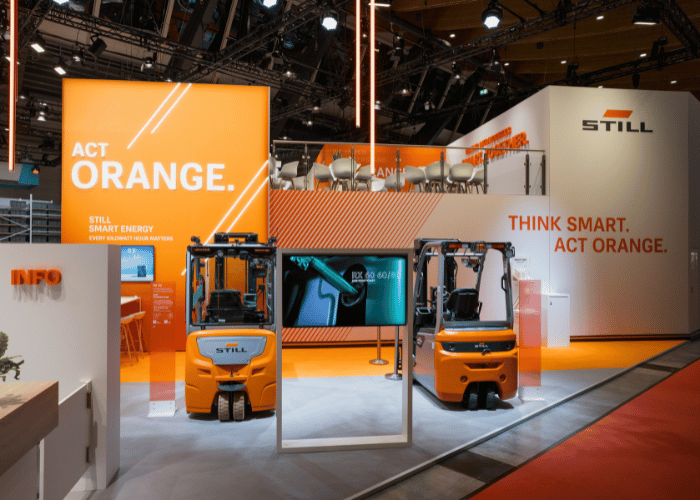
STILL trade show booth at LogiMAT 2026 with a two-story-building and orange design elements.

Given the substantial logistical demands of a large-scale trade show booth spanning roughly 712 m², early material planning plays a vital role. The deliberate choice to use locally sourced resources for STILL’s exhibition presence significantly reduced transport distances. By embedding targeted recycling partnerships directly into the initial concept phase, past projects successfully offset over 5.3 metric tons of CO2. Continuing these circular approaches ensures that approximately 650 kg of high-grade material remains within the resource cycle for this project. Ultimately, the project illustrates how material strategy, component reusability, and resource efficiency can be seamlessly integrated into early design phases.

Future-Proof Brand Architecture: Material Selection as a Strategic Lever

Targeted material selection is a powerful strategic lever for connecting resource-conserving trade show planning with measurable success. Expert consultation helps integrate functional requirements, design aesthetics, and sustainability criteria early in project planning. Here, the quality of the selected construction materials plays a crucial role in enabling long-term utility across multiple project cycles. Co-created solutions contribute to using resources more efficiently and establish a strong foundation for future-oriented brand presences.

DON’T MISS OUT ON ANY MORE UPDATES

Subscribe to our newsletter now and receive the latest blog posts, press releases and exclusive insights straight to your inbox. 

Gain further insights into the world of trade fair and event marketing

avatar
Alejandra Montes Gonzalez
Alejandra Montes Gonzalez is Sustainability Officer at ET GLOBAL on topics related to sustainability in the exhibition and events industry. In her articles, she explores how sustainable solutions can be implemented in a practical and transparent way.