
Trade show booths are often used for just a few days, but their environmental impact lasts for years. At the same time, requirements for resource efficiency from customers, procurement teams, and sustainability managers are steadily rising. This presents companies with new challenges. Single-use booth constructions frequently lead to high waste volume and unnecessary resource loss, straining both budgets and the environment. How can brand presences be designed with flexibility without starting from scratch every single time? Modular trade show booths and exhibit systems offer a clear, actionable answer.
An eco-consciously engineered modular booth provides the opportunity to combine high-impact brand staging with a more responsible use of materials and resources. Here, we analyze how modular systems function and demonstrate how companies can structure their global presence efficiently.
What Is Modularity and How Does It Serve as a Foundation for a Sustainable Exhibition Stand?
In exhibit architecture, modularity relies on standardized components that can be flexibly combined into a wide variety of spatial structures. These systems include wall elements, flooring structures, and integrated lighting solutions designed for long-term, multi-year use. A sustainably implemented modular booth is characterized by a core structure that remains stable across various booth sizes. This technical approach forms the foundation for a resource-efficient brand presentation in any global market.
The sustainability of modular trade show booths stems from combining technical innovations with process optimizations. Key factors contribute to using resources more efficiently and creating the conditions for a more eco-conscious brand appearance:
-
Consistent circular economy practices and the prerequisites for reusing core components across multiple events.
-
Avoidance of single-use materials and hard-to-separate composite materials in booth construction.
-
Optimized warehousing concepts to reduce logistical overhead and transport emissions.
- High adaptability to varying floor spaces without additional material waste.
Technical Components for Reuse
The durability of a modular system is a major factor in its reusability, enabling extended use of the installed components. Likewise, the technical quality of connecting elements plays a decisive role in determining the overall service life of a modular system. High-quality frame structures allow precise alignment and provide the necessary structural stability for complex builds. By separating the load-bearing framework from graphic fabric coverings, material efficiency is further increased, as only the communication surfaces need to be updated. These modular wall systems thus offer a functional foundation that adapts flexibly to varying booth spaces.
Modular Booth Design as a Sustainable Strategy
Developing a sustainable booth design modularly means accounting for the entire lifecycle of materials starting right in the design phase. The modules used consist of robust materials that withstand numerous assembly cycles without qualitative wear and tear. This circular approach makes it possible to distribute the embodied energy over an extended period. This creates the conditions for utilizing components across multiple events and adapting them to evolving requirements, keeping materials in service longer and deploying resources more efficiently.
Modular systems establish the technical foundation for subsequent reuse. Whether and to what extent components can be redeployed depends on specific project requirements and future deployment opportunities.
Modular Trade Show Booths in Practice
In global exhibition planning, modularity enables high scalability while reducing logistical effort. For example, companies operating multiple events per year across different locations benefit from high component compatibility. A sustainably planned modular booth also reduces the risk of transit damage, as components are optimized for frequent handling and transport. Coordinated warehouse and logistics management helps streamline material flows and flexibly deploy existing systems across different locations.
Case Study: Scalable Brand Architecture for SEW-EURODRIVE
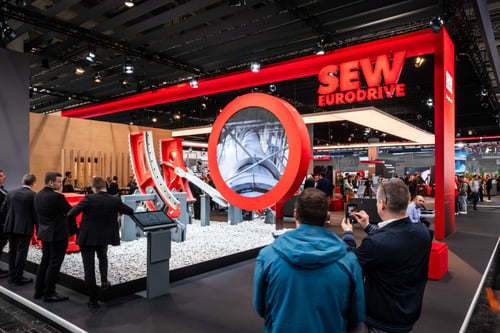
The execution of SEW-EURODRIVE’s trade show presence at Hannover Messe illustrates the efficiency of a well-conceived modular principle. This project demonstrates how a modular booth functions sustainably over years as a stable asset. By utilizing standardized frame and wall elements, even large-scale spaces can be precisely staged and flexibly scaled. These advantages of reusable exhibit systems ensure that elements are prioritized for future deployments and adapted to varying demands, establishing the foundation for the continued use of existing components.
Advantages and Challenges of Modular Trade Show Systems
The strategic balance between functional flexibility and ecological impact is essential for global exhibition planning. A structured comparison highlights the efficiency of modular approaches in professional brand representation.
- 01 Sustainability
- 02 Cost Efficiency
- 03 Planning & Design
- 04 Flexibility
Sustainability
Advantages of Modularity:
Potential reduction of material consumption and waste generation through reusability, decoupling material consumption from event frequency.
Potential Challenges:
Requires proactive asset management for long-term component care and maintenance.
Cost Efficiency
Advantages of Modularity:
Budget stability and potential economic advantages through repeated use, as the basic structure is depreciated as a capital asset over years.
Potential Challenges:
Higher initial investment costs compared to simpler, single-use constructions.
Planning & Design
Advantages of Modularity:
High predictability through recurring system components and proven technical parameters for every setup.
Potential Challenges:
Adherence to system grid dimensions requires precise architectural planning.
Flexibility
Advantages of Modularity:
Rapid response to short-term space changes or varying global locations.
Potential Challenges:
Need for strategic hubs for the professional storage of system components.
The synergy of technical durability and process adaptability makes modular systems like OCTANORM or C8 a valuable tool for sustainable live communication. Forward-looking planning allows system-inherent framework conditions to be optimally utilized for consistent brand presentation.
Projects such as SEW-EURODRIVE’s show that the potential of modular systems becomes particularly evident when brand presences are evolved over multiple years. Long-term usage concepts create the baseline to redeploy existing components and extend their service life.
Why Modularity Is the Ultimate Driver of Sustainability
Choosing modular systems strategically is a necessary response to resource scarcity and global climate goals. Modularity acts as a technological enabler for a circular economy in live communication. Through flexibility and reusability, our modular systems create the conditions to keep materials in service longer. The realized potential depends on factors such as project requirements, storage, and future deployment opportunities. For many international brand presences, modular systems are therefore a key building block toward resource-efficient solutions.
Subscribe to the newsletter now and receive the latest blog posts, press releases and exclusive insights straight to your inbox.
Gain further insights into the world of trade fair and event marketing