
Shrinking budgets and mounting cost pressures are compelling logistics enterprises to fundamentally realign their trade show strategies. Rigid booth concepts restrict agility across changing exhibition spaces and place unnecessary strain on budgets. The answer lies in modular brand architecture that seamlessly unites high-end design with measurable cost efficiency. This article illustrates how modular exhibit systems and reusable components turn exhibition spaces into flexible, cost-effective brand environments, while a decentralized approach paves the way for future-proof, resource-conscious live communication.
In today's dynamic market environment, an in-depth examination of spatial concepts is becoming mission-critical. Specialized industry analyses highlight the trade show sector's transformation toward highly flexible brand spaces, opening up clear perspectives for sustainable brand stewardship and future-ready exhibition design.
Budget Pressures and CAPEX Challenges for Companies in the Logistics Sector
The macroeconomic landscape for transport and logistics enterprises is undergoing a demanding transformation: declining CAPEX budgets require rigorous justification for every marketing expenditure. At the same time, expectations surrounding the visual quality and emotional impact of B2B exhibition spaces continue to climb. To successfully master this balancing act, organizations must fundamentally rethink traditional live-marketing paradigms. A systematic approach helps uncover untapped efficiencies and deploy them with strategic precision.
Shrinking Budgets and Rising Justification Pressure in Live Marketing
Companies face the challenge of proving their investments in physical brand presence with hard figures. Shrinking capital expenditure budgets significantly curtail the scope for temporary, sprawling custom builds at international trade fairs. Yet personal, face-to-face interaction at flagship trade shows remains an indispensable driver for winning new accounts and nurturing client relationships. A modern trade show presence for an intralogistics or broader logistics provider therefore demands intelligent concepts that maximize brand impact despite fiscal constraints.
To this end, decision-makers require precise measurability and transparent cost structures for every square foot of exhibition space. In this environment, collaborative partnerships that guarantee planning reliability and design excellence are setting the industry benchmark. Well-engineered trade show construction in the logistics industry is built on operational efficiency and adapts flexibly to economic realities.
Flexibility as the Key to Navigating Macroeconomic Volatility
The ability to rapidly adapt an exhibition booth to changing formats and budgets significantly enhances agility across international trade show operations. Heavy, rigid booth structures severely restrict adaptability. By contrast, a flexible design approach conserves resources and enables an efficient allocation of capital. Consequently, modern concepts deliver versatile spatial solutions that integrate seamlessly into existing marketing strategies:
-
Standardizing core structural elements shortens time-consuming alignment cycles in the lead-up to an event, freeing up valuable bandwidth for marketing teams to focus on messaging, storytelling, and attendee engagement.
- Eliminating administrative overhead and setup hours leads to a tangible reduction in total project costs, maximizing the overall trade show budget while sustainably elevating organizational efficiency.
The Solution: Modular Systems as a Bridge Between Premium Design and Cost Efficiency
The answer to shrinking budgets is not compromising on design but embracing intelligent standardization. Modular exhibition systems deliver the exact versatility logistics and intralogistics providers need for their international trade show calendars. By combining standardized structural frameworks with bespoke design elements, a powerful synergy emerges: sophisticated brand worlds can be realized cost-effectively and adapted on demand.
Modular Design: Premium Aesthetics and Uncompromising Functionality
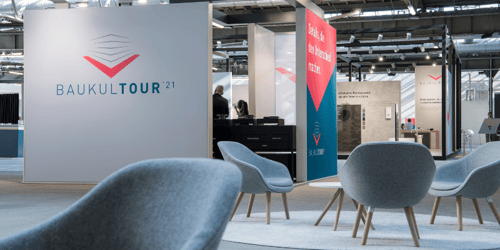
Contemporary modular systems achieve an aesthetic depth and visual polish virtually indistinguishable from conventional custom builds. Designers craft tailored concepts that scale effortlessly across diverse booth dimensions. The strategic combination of reusable structural frames and custom graphic surfaces ensures consistent excellence, establishing a dependable foundation for an impactful and visually stunning trade show presence for logistics enterprises.
For marketing managers, this flexibility provides significant operational relief throughout demanding trade show cycles. Components can be stored efficiently and reconfigured seamlessly for the next venue. This standardization shortens planning timelines and associated costs while maintaining absolute brand consistency across every booth footprint.

Sustainability Through Reusability in Modern Trade Show Construction
Sustainable business practices have long evolved into a hard competitive differentiator and a cornerstone of modern brand stewardship. Minimizing waste and conserving resources are top priorities for forward-thinking organizations. By deploying durable architectural systems, companies can substantially increase the reuse rate of exhibition assets. This circular approach protects natural resources and delivers sustainable relief to corporate marketing budgets over the long run.
Reusing high-grade system components in no way compromises bespoke design standards. On the contrary, it enables the continuous refinement and evolution of an existing booth concept over multiple years. A collaborative partnership supports enterprises in fulfilling both their ecological and economic sustainability goals, empowering logistics brands to achieve maximum market impact with optimized resource input.
Showrooms and Roadshows: Decoupling from Seasonal Trade Show Peaks
The global trade show calendar is traditionally defined by acute seasonal peaks that routinely push internal teams to their operational limits. To level out these high-pressure bottlenecks, forward-looking companies are increasingly investing in year-round brand touchpoints. Corporate showrooms and mobile roadshows offer an exceptional strategic alternative, enabling ongoing customer dialogue independent of rigid trade show schedules.
Year-Round Brand Presence Through Permanent Exhibition Spaces
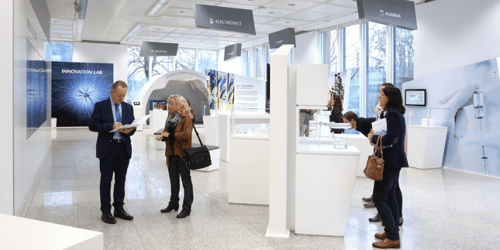
Establishing permanent exhibition environments at corporate headquarters shifts live communication into a fully controlled, high-value setting. Clients and partners can be hosted in an exclusive atmosphere that facilitates deep, focused engagements. This continuous availability alleviates peak workloads for marketing departments and distributes budgets and resources evenly throughout the business year. Furthermore, a permanent showroom serves as a premier venue for client training and internal corporate functions.
Mobile Roadshows as a Dynamic Tool for Direct Customer Engagement
Mobile roadshows represent another compelling channel for delivering brand messaging directly to the customer's doorstep. For this purpose, agile spatial concepts are engineered for rapid installation and dismantling across diverse regional locations. These dynamic formats foster genuine emotional resonance and solidify long-term client relationships. By liberating brand communication from inflexible trade show calendars, companies gain strategic agility throughout the entire year.
Targeted deployments across select regional markets minimize audience wastage by aligning directly with local customer requirements. To safeguard the commercial viability of multi-stop tours, compact and modular display systems keep logistical and freight costs strictly controlled. Insights gathered through immediate dialogue feed directly into refining sales strategies. This real-time transfer of market intelligence positions the roadshow as an exceptionally high-yield, high-performance asset within the global B2B marketing mix.
Quantifiable Efficiency Gains in Trade Show Construction for the Logistics Sector
Successful live marketing relies not merely on creative vision but on measurable outcomes and rigorous financial metrics. An intelligently orchestrated, decentralized trade show model delivers the hard data required to prove value. Combining shortened freight corridors with reusable systems conserves capital and reduces carbon footprints. As a result, strategic cost savings can be accurately quantified and reported with confidence to corporate stakeholders and executive boards.
Sustainability and Performance: The STILL Case Study at LogiMAT
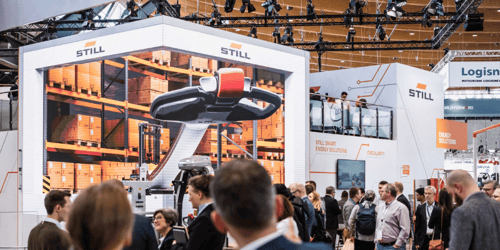
The project executed for the intralogistics leader STILL at LogiMAT provides a compelling real-world demonstration of high-performance exhibition construction. Through the disciplined application of modular, reusable system components, carbon emissions were reduced substantially. Concurrently, STILL recorded a remarkable 48% increase in booth foot traffic compared to previous years. This case study demonstrates that environmental stewardship and commercial performance do not just coexist but actively reinforce one another.
Strategic Efficiency as the Foundation of Future-Ready Live Communication in Logistics
Commercial success and design excellence are by no means mutually exclusive in modern trade show architecture; rather, they are fundamentally interdependent under today's budget realities. By strategically deploying intelligent standardization and regionally accessible modular components, logistics enterprises can effectively counterbalance rising cost pressures. A deliberate transition to circular, reusable frameworks empowers forward-thinking organizations to establish a versatile, sustainable global footprint. This strategic evolution in brand architecture safeguards long-term market competitiveness across a demanding B2B landscape.
Upon this foundation, logistics leaders resolve the classic dilemma between strict cost discipline and high-caliber brand aesthetics in physical environments. Strategically combining modular flexibility with decentralized storage across global hubs delivers the planning certainty required for complex marketing initiatives. The harmonious interaction of these factors produces a highly efficient, scalable brand architecture that adapts dynamically to changing market conditions. As a result, the entire live-marketing program rests on a dependable foundation that guarantees predictability across the annual trade show calendar.
Treating brand environments as reusable systems also relieves strain on internal teams and elevates overall marketing performance year-round. Throughout this collaborative process, the design team aligns aesthetics and functional utility with targeted brand messaging. Uniting environmental objectives with fiscal efficiency is the decisive lever for future-proof brand activations. Ultimately, it is this seamless integration of strategic foresight, modular creativity, and circular resource management that secures the enduring success of global brand architectures.
Gain further insights into the world of trade fair and event marketing