
Skip to content

3D Smart Automation: How Trade Shows Stage Industrial Systems

Presenting multi-ton automation systems within traditional exhibition spaces poses complex challenges for industrial companies. In modern trade show construction for mechanical engineering, conventional booth concepts quickly hit architectural limits when trying to bring abstract manufacturing processes to life. To overcome these hurdles effectively, well-conceived spatial staging transforms rigid product displays into dynamic experience worlds. By strategically pairing interactive formats with intelligent automation technologies, complex value chains become clearly understandable. This article demonstrates how thoughtful spatial storytelling sustainably drives lead generation at industrial trade shows.

Why Traditional Trade Show Construction Hits Physical Limits in Mechanical Engineering

The physical representation of modern automation technology at industrial trade shows faces fundamental structural challenges. Heavy equipment can rarely be installed at full scale on an exhibition floor due to floor load limits, hall ceiling heights, and transportation costs. At the same time, highly complex software processes and automated workflows often remain invisible to decision-makers when relying solely on static exhibits.

The Complexity of Industrial Plants within a Limited Brand Space

Industrial automation systems are defined by high connectivity and multi-layered process workflows. When companies try to depict these systems within a standard booth footprint, the result is often visual overload without a clear focal point. However, the buying center in mechanical engineering and automation—comprising engineers, financial decision-makers, and executive board members—requires tailored information offerings to make sound investment decisions. A purely passive exhibition booth rarely succeeds in conveying a system's specific competitive advantages within a few minutes. This creates the clear need to break through spatial boundaries using targeted digital extensions and kinetic staging.
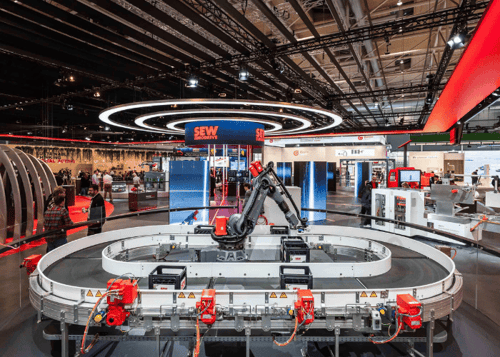
Supervision of the SEW-EURODRIVE stand at the Hannover Messe trade fair for mechanical engineering and automation, featuring a large area for machine demonstrations.

Kinetic Spatial Staging and Interaction: Making Abstract Automation Processes Tangible

Making the invisible intelligence of modern manufacturing systems visible requires innovative approaches to spatial design. Combining physical architecture, clear instructional design, and digital interfaces turns complex machinery into tangible stories. Through the targeted use of interactive formats, trade show visitors transform from passive observers into active participants in the action.

Interactive Engineering Exhibits: Gamification and AGVs in Action

Translating complex technology for instructional impact requires a thoughtful synergy of human interaction and automated mechanics. Interactive exhibits leverage gamification elements to visualize abstract data streams and control commands in real time. When trade visitors can adjust system parameters themselves, their understanding of the solution's overall efficiency increases noticeably.

This combination of playful engagement and technological precision ensures that all decision-makers are engaged at their respective level of authority. A well-conceived brand space unifies these perspectives into a harmonious overall experience. In this way, the booth becomes a hub of knowledge transfer that remains top-of-mind for key decision-makers long after the event.

The following core concepts demonstrate how automated guided vehicles (AGVs) and gesture control systems are successfully integrated into booth architecture:
  • Gesture Control for Automated Guided Vehicles (AGV): Visitors maneuver autonomous transport robots touchlessly using hand gestures through a scaled-down area, making intralogistics processes tangible through play.

  • Gamified Process Simulation: Via touch terminals or mixed-reality headsets, booth visitors solve real bottlenecks in a virtual factory and experience the instant system reaction in a physical model.

  • Kinetic Model Staging: Dynamic moving modules and synchronized LED screens highlight the flow of materials and data across a complex production line in interplay with customized kinetic spatial staging.

  • Digital Twins on the Exhibit: Physical components are augmented by holographic overlays to transparently reveal internal processes, maintenance intervals, and real-time performance data.
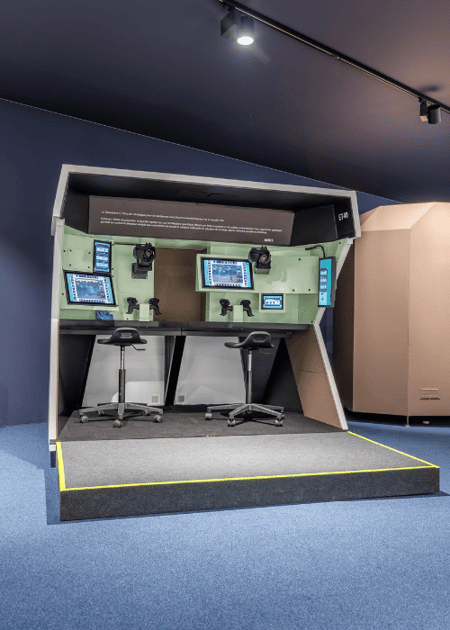

Gamification area at the KNDS exhibition stand.

From Passive Product Displays to Leads: Trade Show Success Through Spatial Architecture

Evolving from a purely static product display to an experience-oriented space concept is not an aesthetic end in itself. On the contrary, real-world practice shows that a well-crafted narrative increases the efficiency of the entire trade show presence. When complex technologies are presented clearly, the dwell time of qualified decision-makers at the booth increases significantly. This targeted activation translates directly into both the volume and quality of sales leads generated.

Building spatial staging for complex industrial machinery requires a precise balance between engineering accuracy and an innovative culture of experience. Brands that make abstract processes tangible through interactive exhibits and kinetic elements earn the trust of their entire audience. In this way, a thoughtful brand space transforms technological complexity into a decisive sales advantage for live communication.

Don’t miss any more updates
Subscribe to our newsletter now and receive the latest blog posts, press releases and exclusive insights straight to your inbox.

Gain further insights into the world of trade fair and event marketing

avatar
Ilker Celik
Ilker Celik is Digital Marketing Manager at ET GLOBAL and a blog author focusing on trade fair design, event architecture, and holistic brand spaces. He is passionate about data‑driven marketing and the effective combination of content, performance, and technology to create engaging and measurable brand experiences.