
Skip to content
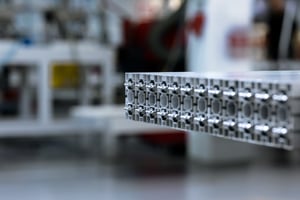
Close-up of an octanorm aluminium system profile with precise grid structure, used as a core structural component for modular brand spaces in exhibition construction.

The Future of Modular Brand Spaces in Trade Show Design

ET GLOBAL in an Interview with OCTANORM

April 15, 2026

Modular brand spaces, sustainable trade show construction, and experience-oriented concepts are shaping the future of trade show appearances. In this interview, we take a look at industry developments, technological innovations, and the role of modular systems as strategic infrastructure for modern brand communication together with Benjamin Bruder, Managing Director of OCTANORM-Vertriebs-GmbH and President of ospi.
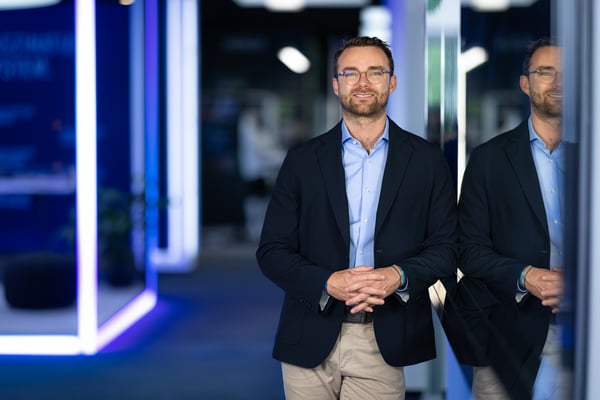
Managing Director of octanorm standing in a modern modular exhibition environment with LED lighting and reflective surfaces, representing modular brand spaces in exhibition construction.


Partnership between ET GLOBAL and octanorm

ET GLOBAL:

ET GLOBAL and octanorm have been working together successfully for many years. What do you think makes this partnership special, and how has it evolved over time?
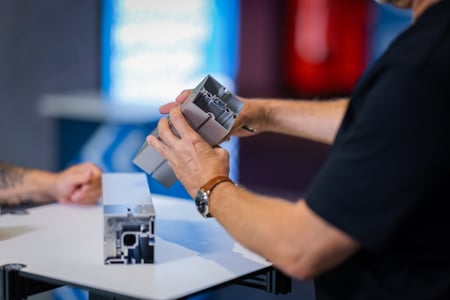
Hands assembling and demonstrating an octanorm aluminium profile on a table, used as a technical system component for modular brand spaces in exhibition construction.


Benjamin Bruder:

This partnership is characterized above all by reliability, innovation, and a shared commitment to quality. ET GLOBAL transforms technical possibilities into powerful brand experiences and octanorm provides the flexible, high-quality, and cost-effective foundation for this.

Looking at the overall development, it becomes clear that the requirements for system solutions have also changed:

In the past, the focus was more on technical functionality. Today, the emphasis is on integrated solutions—ranging from design, scalability, and sustainability to global applicability. This is only possible because both companies are committed to continuous improvement.


The Evolution of Trade Show Design: From Simply Renting Space to a Strategic Brand Platform

ET GLOBAL:

Looking back over the past 10 to 15 years in the trade show construction industry, what changes have you noticed most?

Benjamin Bruder:

The industry has become significantly more demanding. Trade show appearances are now more integral to brand management, more experience-oriented in execution, and at the same time more efficient in terms of planning, logistics, and budgeting.

A particularly influential factor here is the growing importance of sustainability:

The increasing importance of sustainability has also been particularly influential. Reusability, resource conservation, and CO2 considerations are now key criteria and have given modular systems additional relevance.


ET GLOBAL:

Many people today are saying that trade show booths are becoming more strategic and experience-oriented. How does this change the role of modular systems like octanorm?

Benjamin Bruder:

This makes modular systems more important, not less so. They provide the foundation for creating experiential spaces efficiently, flexibly, and to a high standard. Their role is thus shifting from that of a mere construction tool to a strategic infrastructure: they must enable creative freedom, support technical integration, and at the same time be both cost-effective and sustainable.


ET GLOBAL:

In your opinion, what do companies most often underestimate when planning a trade show booth?

Benjamin Bruder:

The importance of clarity is most often underestimated. It’s not the booth size that matters, but the precision of the message: Who do we want to reach, with what story, and with what goal?

Operational complexity is also often taken into account too late:

A strong trade show presence can only be achieved if the concept, system, logistics, setup, media technology, choice of materials, and timing are all planned together from the very beginning.


Innovation, Technology, and Sustainability in Modular Trade Show Construction

ET GLOBAL:

Where do you currently see the most exciting innovations in trade show construction: in architecture, materials, or digital technologies?

Benjamin Bruder:

The most exciting innovations are currently emerging at the intersections. Architecture alone is not enough, nor are new materials alone, nor are digital technologies alone.

Solutions that bring everything together are particularly relevant:

We see great potential in lighter, smarter, and reusable materials, in integrated media technology, and in AI-supported planning and design processes.


ET GLOBAL:

Sustainability is increasingly becoming a key issue in the industry. What role do modular systems play in this, and where do you see potential for development

Benjamin Bruder:

Modular systems play a key role here. Reusability is one of the most effective levers when it comes to conserving resources in trade show construction. A system that can be used in various configurations over many years is superior to a one-off structure in many respects.

At the same time, there is still room for development:

I see potential for development primarily in two areas: first, in further material optimization, and second, in greater transparency regarding life cycles and CO₂ impacts. Sustainability must not be considered solely at the product level but must encompass the entire system.
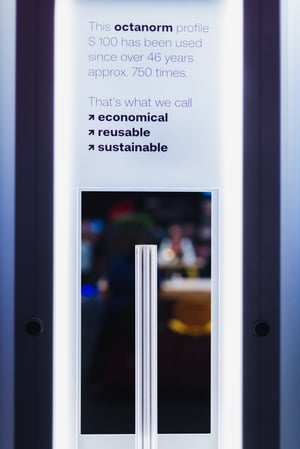
 

Illuminated display featuring an octanorm system profile with text highlighting reuse over 46 years, visualising sustainable modular brand spaces in exhibition construction.

ET GLOBAL:

Is sustainability changing the scope of design freedom in trade show construction?

Benjamin Bruder:

I believe the supposed conflict between design freedom and sustainability is gradually dissolving. Good sustainable construction does not mean sacrificing design, but rather designing more intelligently. The question is no longer: How can we build in the most spectacular way possible? But rather: How can we build as effectively as possible while using the fewest resources?

 

Brand Impact and a Look into the Future of Trade Show Design

ET GLOBAL:

When it comes to collaboration between system manufacturers and trade show stand builders: What is key to transforming a technical solution into a compelling brand space?

Benjamin Bruder:

The key is for both sides to understand and respect each other’s strengths. The systems manufacturer must deliver reliable, flexible, and intelligent solutions. The exhibition stand builder then translates these into brand impact, spatial design, and the quality of the experience.

The focus must remain clear:

A compelling brand space is always created when technology does not visibly dominate, but rather enables design. This requires close dialogue, early coordination, and a shared understanding that, in the end, it is not the system that takes center stage, but the client’s brand.


ET GLOBAL:

What role will physical brand spaces play in the future in an increasingly digital world?

Benjamin Bruder:

The more digital the world becomes, the more valuable real-life, in-person encounters become. People make decisions not only based on information, but also on trust, atmosphere, and experiences. This is exactly what physical brand spaces can achieve like no other medium.

The future is hybrid:

The future is therefore neither purely digital nor purely physical, but intelligently connected. The trade show booth is becoming an integral part of a larger communication ecosystem: with digital touchpoints, data, content, and hybrid formats. But the physical space remains central because it creates proximity, credibility, and emotional connection.


ET GLOBAL:

If you look ten years into the future: What will a trade show booth look like in 2035?

Benjamin Bruder:

I believe that the trade show booth of 2035 will be significantly more adaptive, data-driven, and sustainable. It will be more modular at its core, yet more personalized in its expression. Systems will be even more flexible, lighter, and capable of smarter connectivity. At the same time, the booth will be better able to adapt to different usage scenarios. From product presentation to community building to content production. Furthermore, the lifecycle will be taken into account much more closely. Materials, reuse, transport efficiency, and digital planning will be an integral part of every design. The booth of the future will not only be beautiful and functional, but also measurably efficient and built responsibly.


ET GLOBAL:

How is AI changing the design and production of trade show booths?

Benjamin Bruder:

AI won’t replace trade show design, but it will make the process significantly more efficient. It’s particularly helpful in the early stages of a project, allowing us to visualize ideas more quickly, test different options, and streamline the approval process. In the future, it will certainly provide even greater support for planning and execution. But the most important aspects will always be human: an understanding of the brand, creativity, and the ability to use technology to create a compelling space.


Personal conclusion to the interview

ET GLOBAL:

Is there a project or a moment in your career that particularly illustrates to you why this industry is so fascinating?

Benjamin Bruder:

What makes this industry so fascinating to me are, above all, the people. In trade show construction, success always stems from the collaboration of many people—combining experience, creativity, speed, and tremendous dedication. And I’m always impressed by how something is built in such a short time, makes a huge impact for a few days, and then disappears again. This dynamism and this special energy are what make our industry so appealing.


Conclusion: What companies can specifically take away from the interview

The conversation between ET GLOBAL and octanorm clearly demonstrates that trade show design has evolved in recent years. Not only in terms of aesthetics but, above all, strategically.

Three key insights can be drawn from the interview:

  1. Modular systems are not a limitation but a prerequisite for modern brand spaces. Modularity does not imply standardization in a negative sense, but rather planning reliability, scalability, and reusability. Especially in international settings, with multiple trade show appearances per year or varying booth sizes, a modular core system enables consistent brand impact while offering high adaptability. What matters is not the system itself, but how it is implemented and further developed.

  2. Sustainability does not result from individual measures, but from systemic decisions. The interview makes it clear that sustainability in trade show construction is most effective when life cycles, reuse, material selection, and logistics are considered together. A modular trade show booth that is used in various configurations over the years is often more environmentally and economically sensible than spectacular one-off solutions. For companies, this means: Sustainable trade show appearances do not begin with the materials, but with the strategic concept.

  3. The success of a trade show presence is determined before the first day of setup. It is repeatedly emphasized how crucial clarity in objectives, messaging, and the usage concept is. It is not the size of the booth, but the precision of the brand story that determines its impact. Modular systems, digital technologies, and design solutions can only demonstrate their strengths if they are integrated early on and aligned with a clear communication goal. Trade show construction is thus less of a construction project and more of a coordination and translation process between brand, space, and technology.

For ET GLOBAL, this means: trade show construction does not end with construction or design. It begins with the question of what role the space should play for the brand—today, tomorrow, and over the coming years. Collaboration with system partners such as octanorm demonstrates how technical modularity can give rise to sustainable, flexible, and effective brand spaces.

IMG_9926
IMG_9900
IMG_9934
IMG_9914
ET_Web_CTA-3

ARE YOU READY FOR YOUR NEXT TRADE SHOW BOOTH?